Pim Stones: Neon Lights
- Abbi Christine
- Dec 9, 2021
- 3 min read




I'm gonna love you with all I've got,
Even if it kills me, you're the one that I want
The world baby is scary, I know,
So close your eyes, hold me tight and don't let go
Still you try, And finally, now I know why
Leave it all behind, you know we could
I'll teach you how to split wood, you'll teach me how to be good.
I'll follow you down to the river to pray
Neon Lights: Lyricism
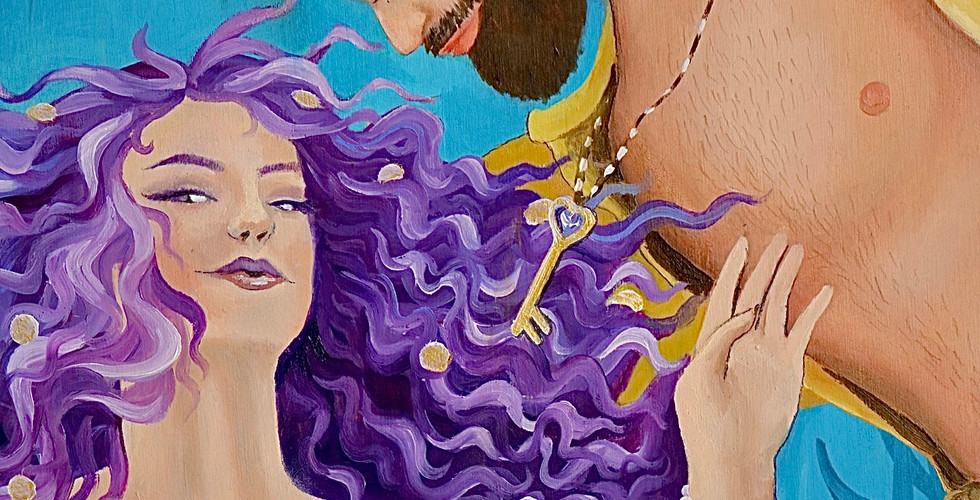
This song is more emotionally explicit than environmentally so. He describes a relationship that is fraught with trouble, without saying this directly. Instead, he emphasizes that the world they are up against “is scary,” and that it can be solved by holding on tight. “I’ll follow you down to the river” is the only scene he provides, aside from the Little Mermaid-esque trade-off of the male character teaching the woman from another world to “split wood” while she can teach him “to be good.” Several other themes led the characters in my painting to murky depths: “I’m gonna love you with all I’ve got, even if it kills me,” specifies that he will follow the siren into the deep; “the world baby is scary,” he sings, as she is nearly consumed by darkness at an unknown depth; “you still have faith in me baby that’s why I’ll go,” indicates that her faith is enough for him to try, even if he is rising to the surface, unable to fully be with her. “I’ll follow you down to the river for prayer, and I’ll never let you know the truth, that no one’s there,” also shows that the woman may be naive to not notice there is no one else like him in her home.
He is cloaked in a billowing yellow blousy shirt, similar to a 17th-century sailor who has followed a siren into the sea. Gilded daffodils subtly mark the hem of his shirt; the flower
symbolizes unrequited and broken love, likewise suggested by the mermaid’s pearls which represent her mystery and inaccessibility to him. The bottom corners of the Lyricism painting are framed by amethyst, mirroring her purple adornment. Amethyst serves dual purpose in representing the feminine mystique and one-sided love of the song. It has long been revered as the stone of Venus, known for her allure and attractive power. St. Valentine wore amethyst on his finger to proclaim willingness to secretly marry soldiers and sailors to their lovers. St. Valentine’s Key also originally was associated with Amethyst, and is given as a token to unlock the heart of a lover who bestows it.
Neon Lights: Chromesthetics
“I’ll follow you down” he repeats, echoing into the background in vain. On top of his lyrical promise to stay with her, the man’s body is physically rising towards the surface despite his echoed promise in the Lyrical painting. The distinct visual pattern also repeats itself in the Chromesthetic painting to illustrate the sensation of rising that appears in this song.
My synesthetic mind sees this song as somewhat pointy. Compositionally this is due to a sort of distorted pizzicato (plucked) string section that repeats throughout. Since Pim Stones uses his own music production abilities to create his music, his access to a full string section is likely limited. As such, he, like many producers, is able to utilize a software manufactured sound of pizzicato strings and apply frequency adjustments or any other range of production techniques to veil the plucked sound. Copying the pizzicato strings is the sound of a piano to add further percussive “pinginess” to the instrumentation. This pointiness is displayed in my painting with the harsh streaks of color that rise upward as if reaching for the surface of the water.
Rhythmically, this song swings along to provide a sense of waves to the overall feeling of the piece. The drum beat is represented visually through the purple blocks that appear in my mind as the swung rhythm rolls throughout the song. Constantly this song moves forward with a smooth but hasty feeling. Accompanying the rolling along of the rhythm is the tone of Pim’s voice. He utilizes reverb on his voice to provide a sense of distance from the ears of the listener and the issuing of his voice. In addition to providing this distance with reverb, he doubles his own voice and has two layers of himself singing the same line to provide a slight offset between his consonant sounds. This adds to the feeling of being underwater. To convey this vocal distance, I’ve placed his voice as being the white mist, similar to the previous painting, winding behind the rest of the music.


Comments